CATCH THE WAVE

Myrtle Beach Real Estate

We Specialize in Myrtle Beach, SC Real Estate. Lots of options are waiting for you in Myrtle Beach, South Carolina and choosing the right realtors can help you in finding the perfect area and the right home for you and your family and make your dream a reality!  Let us help you in making one of the biggest, if not the biggest, decisions in your life.   

We were both born and raised along the Grand Strand and know the entire Horry County, so no matter what style of home you are looking for or what area you prefer, we can help you!  Please give us a call and let us help you make your dream a reality!  843-222-8566.

Eddie & Julie Boyd - The Boyd Team - Realtors

Myrtle Beach Real Estate - INNOVATE Real Estate


March 26, 2018

5 Reasons Why To Sell This Spring

5 Reasons Why to Sell This Spring!

5 Reasons Why to Sell This Spring! | MyKCM

Here are five reasons listing your home for sale this spring makes sense.

1. Demand Is Strong

The latest Buyer Traffic Report from the National Association of Realtors (NAR) shows that buyer demand remains very strong throughout the vast majority of the country. These buyers are ready, willing and able to purchase…and are in the market right now! More often than not, multiple buyers are competing with each other to buy a home.

Take advantage of the buyer activity currently in the market.

2. There Is Less Competition Now

Housing inventory has declined year over year for the last 32 months and is still under the 6-month supply needed for a normal housing market. This means that, in the majority of the country, there are not enough homes for sale to satisfy the number of buyers in the market. This is good news for homeowners who have gained equity as their home values have increased. However, additional inventory could be coming to the market soon.

Historically, the average number of years a homeowner stayed in their home was six but has hovered between nine and ten years since 2011. There is a pent-up desire for many homeowners to move as they were unable to sell over the last few years because of a negative equity situation. As home values continue to appreciate, more and more homeowners will be given the freedom to move.

The choices buyers have will continue to increase. Don’t wait until this other inventory comes to market before you decide to sell.

3. The Process Will Be Quicker

Today’s competitive environment has forced buyers to do all they can to stand out from the crowd, including getting pre-approved for their mortgage financing. This makes the entire selling process much faster and much simpler as buyers know exactly what they can afford before home shopping. According to Ellie Mae’s latest Origination Insights Report, the average time it took to close a loan was 45 days.

4. There Will Never Be a Better Time to Move Up

If your next move will be into a premium or luxury home, now is the time to move up! The inventory of homes for sale at these higher price ranges has forced these markets into a buyer’s market. This means that if you are planning on selling a starter or trade-up home, your home will sell quickly, AND you’ll be able to find a premium home to call your own!

Prices are projected to appreciate by 4.8% over the next year according to CoreLogic. If you are moving to a higher-priced home, it will wind up costing you more in raw dollars (both in down payment and mortgage payment) if you wait.

5. It’s Time to Move on With Your Life

Look at the reason you decided to sell in the first place and determine whether it is worth waiting. Is money more important than being with family? Is money more important than your health? Is money more important than having the freedom to go on with your life the way you think you should?

Only you know the answers to the questions above. You have the power to take control of the situation by putting your home on the market. Perhaps the time has come for you and your family to move on and start living the life you desire.

That is what is truly important.

Posted in BoydTeam Blog
March 19, 2018

The Cost of Waiting: Interest Rates Edition [INFOGRAPHIC]


The Cost of Waiting: Interest Rates Edition [INFOGRAPHIC]


The Cost of Waiting: Interest Rates Edition [INFOGRAPHIC] | Simplifying The Market

Posted in BoydTeam Blog
March 19, 2018

Should I Wait Until Next Year to Buy? Or Buy Now? [INFOGRAPHIC]


Should I Wait Until Next Year to Buy? Or Buy Now? [INFOGRAPHIC]


Should I Wait until next Year to Buy? Or Buy Now? [INFOGRAPHIC] | Simplifying The Market

Posted in BoydTeam Blog
March 19, 2018

Dreaming of a Luxury Home? Now’s the Time!

 Dreaming of a Luxury Home? Now’s the Time!

If your house no longer fits your needs and you are planning on buying a luxury home, now is a great time to do so! Recently, the Institute for Luxury Home Marketing released its Luxury Market Report which showed that in today’s premium home market, buyers are in control.

The inventory of homes for sale in the luxury market far exceeds the number of people searching to purchase these properties in many areas of the country. This means that homes are often staying on the market longer or can be found at a discount.

Those who have a starter or trade-up home to sell will find buyers competing, and often entering bidding wars, to be able to call their house their new home.

The sale of your starter or trade-up house will help you come up with a larger down payment for your new luxury home. Even a 5% down payment on a million-dollar home is $50,000.

But not all who are buying luxury properties have a home to sell first.

A recent Bloomberg article gave some insight into what many millennials are choosing to do:

“A new generation of affluent homebuyers powered by a surge in inherited wealth is driving the luxury-home market, demanding larger spaces and fancier finishes, according to a report heralding ‘the rise of the new aristocracy.’”

Bottom Line

The best time to sell anything is when demand is high, and supply is low. If you are currently in a starter or trade-up house that no longer fits your needs and you are looking to step into a luxury home, now’s the time to list your house for sale and make your dreams come true.

Posted in BoydTeam Blog
March 14, 2018

7 Factors to Consider When Choosing A Home to Retire In


7 Factors to Consider When Choosing A Home to Retire In


As more and more baby boomers enter retirement age, the question of whether or not to sell their homes and move will become a hot topic. In today’s housing market climate, with low available inventory in the starter and trade-up home categories, it makes sense to evaluate your home’s ability to adapt to your needs in retirement.

According to the National Association of Exclusive Buyers Agents (NAEBA), there are 7 factors that you should consider when choosing your retirement home.

1. Affordability

“It may be easy enough to purchase your home today but think long-term about your monthly costs. Account for property taxes, insurance, HOA fees, utilities – all the things that will be due whether or not you have a mortgage on the property.”

Would moving to a complex with homeowner association fees actually be cheaper than having to hire all the contractors you would need to maintain your home, lawn, etc.? Would your taxes go down significantly if you relocated? What is your monthly income going to be like in retirement?

2. Equity

“If you have equity in your current home, you may be able to apply it to the purchase of your next home. Maintaining a healthy amount of home equity gives you a source of emergency funds to tap, via a home equity loan or reverse mortgage.”

The equity you have in your current home may be enough to purchase your retirement home with little to no mortgage. Homeowners in the US gained an average of over $14,000 in equity last year.

3. Maintenance

“As we age, our tolerance for cleaning gutters, raking leaves and shoveling snow can go right out the window. A condominium with low-maintenance needs can be a literal lifesaver, if your health or physical abilities decline.”

As we mentioned earlier, would a condo with an HOA fee be worth the added peace of mind of not having to do the maintenance work yourself?

4. Security

“Elderly homeowners can be targets for scams or break-ins. Living in a home with security features, such as a manned gate house, resident-only access and a security system can bring peace of mind.”

As scary as that thought may be, any additional security and an extra set of eyes looking out for you always adds to peace of mind.

5. Pets

“Renting won’t do if the dog can’t come too! The companionship of pets can provide emotional and physical benefits.”

Evaluate all of your options when it comes to bringing your ‘furever’ friend with you to a new home. Will there be necessary additional deposits if you are renting or in a condo? Is the backyard fenced in? How far are you from your favorite veterinarian?

6. Mobility

“No one wants to picture themselves in a wheelchair or a walker, but the home layout must be able to accommodate limited mobility.”

Sixty is the new 40, right? People are living longer and are more active in retirement, but that doesn’t mean that down the road you won’t need your home to be more accessible. Installing handrails and making sure your hallways and doorways are wide enough may be a good reason to look for a home that was built to accommodate these needs.

7. Convenience

“Is the new home close to the golf course, or to shopping and dining? Do you have amenities within easy walking distance? This can add to home value!”

How close are you to your children and grandchildren? Would relocating to a new area make visits with family easier or more frequent? Beyond being close to your favorite stores and restaurants, there are a lot of factors to consider.

Bottom Line

When it comes to your forever home, evaluating your current house for its ability to adapt with you as you age can be the first step to guaranteeing your comfort in retirement. If after considering all these factors you find yourself curious about your options, let’s get together to evaluate your ability to sell your house in today’s market and get you into your dream retirement home!


Posted in BoydTeam Blog
March 13, 2018

A city through the years: Myrtle Beach celebrates 80th anniversary


A city through the years: Myrtle Beach celebrates 80th anniversary


Myrtle Beach is officially 80 years old.

On March 12, 1938, Myrtle Beach was incorporated as a town by a vote of 133 to 8. Now, the city is celebrating its 80th anniversary and an eventful history.

"City Council will celebrate tomorrow, Tuesday, March 13, during the regular meeting," the city's Facebook page reads. "Happy 80th birthday Myrtle Beach!"

Myrtle Beach through the years

The City of Myrtle Beach has carried different identities over the years, including an Air Force base and now as a popular tourist destination.

Shortly after its incorporation, the Air Force base was established in what is now The Market Common. The base closed in 1993.

In 1949, the Pavilion, a popular destination among locals and tourists, opened. The park was demolished in 2007 after closing to the public in September 2006.

The park sat on 11 acres and featured a German Baden-Band Organ, roller coasters and the popular Herschell-Sillman Carousel, which was built in 1912.

After years of sitting empty, a zip-line attraction now sits on the lot, and is home to the Carolina Country Music Festival.

In 1954, The Grand Strand was hit with Hurricane Hazel, forcing cities and towns along the coast to rebuild, according to the Visit Myrtle Beach website.


Nineteen years after its incorporation, the town officially became a city on Jan. 4, 1957. In order to become a city, the town's population had to exceed 5,000 residents.

RELATED STORIES FROM MYRTLE BEACH SUN NEWS

Shorty after, a golf boom hit the area, with nearly 115 courses spanning the Grand Strand, the website reads.

Myrtle Beach has changed drastically over the years, and the area keeps growing.

Last year, the city announced that development is "booming," with nearly $411 million worth of new construction that was approved between July 2016 and July 2017.

However, icons still span Ocean Boulevard including the Gay Dolphin Gift Cove, which has been open since 1946. Family Kingdom Amusement Park opened around 1966 and is still open today. It was originally named "Grand Strand Amusement Park."


Posted in BoydTeam Blog
March 13, 2018

Competition is Coming, Are You Thinking of Selling Your Home?


Competition is Coming, Are You Thinking of Selling Your Home?


The number of building permits issued for single-family homes is the best indicator of how many newly built homes will rise over the next few months. According to the latest U.S. Census Bureau and U.S. Department of Housing & Urban Development Residential Sales Report, the number of these permits were up 7.4% over last year.

How will this impact buyers?

More inventory means more options. Lawrence Yun, NAR’s Chief Economist, explained this is good news for the housing market – especially for those looking to buy:

“This rise in single-family housing construction will help tame home price growth, and the increase in multifamily units should continue to help slow rent growth.”

How will this impact sellers?

More inventory means more competition. Today, because of the tremendous lack of inventory, a seller can expect:

  1. A great price on their home as buyers outbid each other for it
  2. A quick sale as buyers have so little to choose from
  3. Fewer hassles as buyers don’t want to “rock the boat” on the deal

With an increase in competition, the seller may not enjoy these same benefits. As Chief EconomistNela Richardson, added:

“Because existing home inventory has been so low for so long, new construction is taking a larger share of the market…Builders meet the buyers and see the demand firsthand.”

Bottom Line

If you are considering selling your house, you’ll want to beat this new competition to market to ensure you get the most attention for your listing and the best price.


Posted in BoydTeam Blog
March 13, 2018

Housing Market Expected To “Spring Forward” This Year


Housing Market Expected To “Spring Forward” This Year


Just like our clocks this weekend in the majority of the country, the housing market will soon “spring forward!” Similar to tension in a spring, the lack of inventory available for sale in the market right now is what is holding back the market.

Many potential sellers believe that waiting until Spring is in their best interest, and traditionally they would have been right.

Buyer demand has seasonality to it, which usually falls off in the winter months, especially in areas of the country impacted by arctic temperatures and conditions.

That hasn’t happened this year.

Demand for housing has remained strong as mortgage rates have remained near historic lows. Even with the recent increase in rates, buyers are still able to lock in an affordable monthly payment. Many more buyers are jumping off the fence and into the market to secure a lower rate.

The National Association of Realtors (NAR) recently reported that the top 10 dates sellers listed their homes in 2017 all fell in April, May, or June.

Those who act quickly and list now could benefit greatly from additional exposure to buyers prior to a flood of more competition coming to market in the next few months.

Bottom Line

If you are planning on selling your home in 2018, let’s get together to evaluate the opportunities in our market.

Posted in BoydTeam Blog
March 13, 2018

You Can Save for a Down Payment Faster Than You Think!


You Can Save for a Down Payment Faster Than You Think!


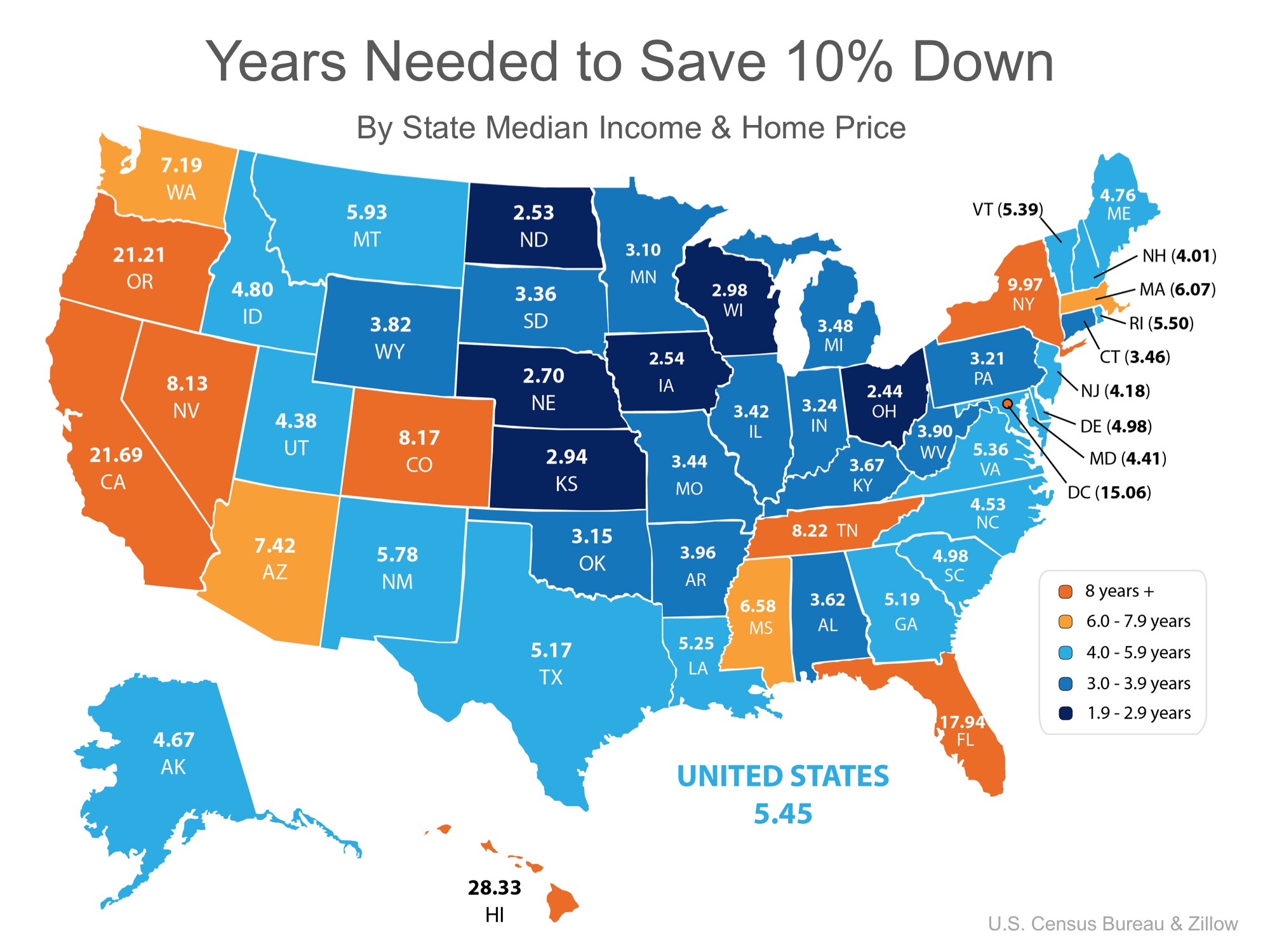
Saving for a down payment is often the biggest hurdle for a first-time homebuyer. Depending on where you live, median income, median rents, and home prices all vary. So, we set out to find out how long it would take to save for a down payment in each state.

Using data from the United States Census Bureau and Zillow, we determined how long it would take, nationwide, for a first-time buyer to save enough money for a down payment on their dream home. There is a long-standing ‘rule’ that a household should not pay more than 28% of their income on their monthly housing expense.

By determining the percentage of income spent renting in each state, and the amount needed for a 10% down payment, we were able to establish how long (in years) it would take for an average resident to save enough money to buy a home of their own.

According to the data, residents in Ohio can save for a down payment the quickest in just under 3 years (2.44). Below is a map that was created using the data for each state:

You Can Save for a Down Payment Faster Than You Think! | Simplifying The Market

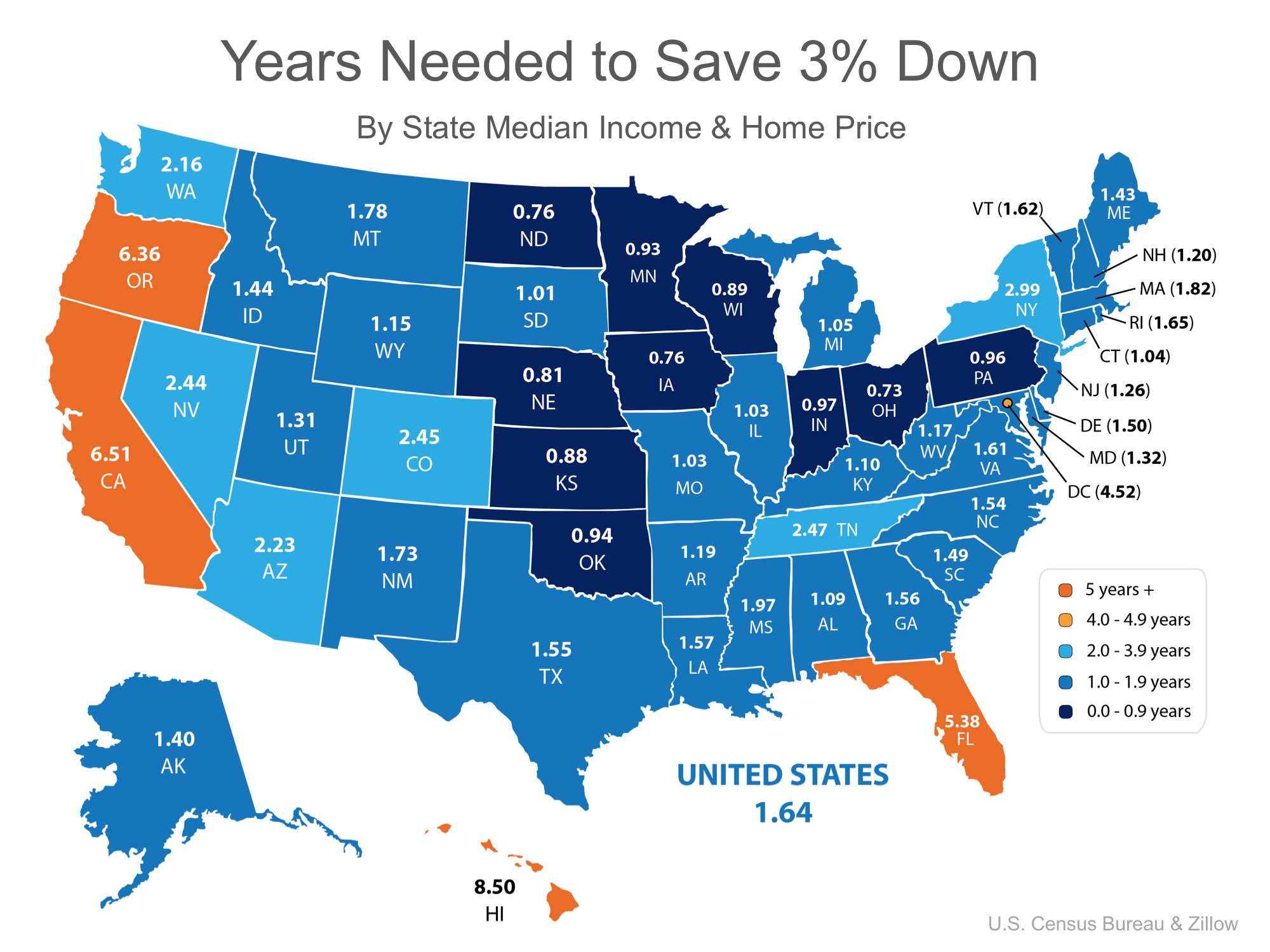
What if you only needed to save 3%?

What if you were able to take advantage of one of Freddie Mac’s or Fannie Mae’s 3%-down programs? Suddenly, saving for a down payment no longer takes 5 or 10 years, but becomes possible in a year or two in many states as shown on the map below.

You Can Save for a Down Payment Faster Than You Think! | Simplifying The Market

Bottom Line

Whether you have just started to save for a down payment, or have been saving for years, you may be closer to your dream home than you think! Let’s meet up so I can help you evaluate your ability to buy today.


Posted in BoydTeam Blog
March 13, 2018

What Homebuyers Should Know About Smart Homes

hat Homebuyers Should Know About Smart Homes


Smart home technology is all the rage lately, touted as anything from a fun set of individual gadgets to an integrated and connected way to protect your family. But what does it actually mean? And what do you need to know as you shop for a new home? Here are the smart home basics to make your home-buying process easier:

Features to Look for

The phrase “smart home” is a catch-all for any residence that uses connected technology to remotely control things like lights, security systems, locks and more. In addition to giving users the ability to manage devices from anywhere via an app, most smart homes also have a central hub that allows one device to trigger actions in another without user intervention. For example, a connected smart home can give you the power to—all at once—lock the door, turn off the lights, adjust the thermostat, activate a security camera and more.

Because the definition of a smart home is so broad, it might refer to a home that only has programmable light bulbs, or a home where you can fully control the security, HVAC and entertainment systems. Moreover, some smart tech home devices easily move with the owner, while some are part of a more permanent installation. Before making an offer on a home with smart features, ask which capabilities are present and which will remain after the sale. Some common technologies include:

  • Light switches/light bulbs
  • Wall outlets
  • Thermostats/heating and cooling systems
  • Door locks
  • Garage door openers
  • Entertainment systems
  • Appliances
  • Security cameras and sensors
  • Emergency alert systems (smoke and carbon dioxide detectors)
  • Environmental sensors (humidity, water, etc.)
  • Shades and drapes
  • Irrigation systems

These devices can be integrated into one platform and work together to provide you with increased security, efficiency and peace of mind. They can alert you from afar to your kids arriving home from school, a burst water pipe or the completion of your laundry. From your smartphone, you can easily turn off the lights the kids always manage to leave on, or turn off the iron that you forgot to unplug as you hurried out the door. Your devices can even save time by managing tasks like opening and closing shades and watering the lawn only when needed.

Ongoing Costs and Subscription Fees

If you’re looking at purchasing a smart home, you’ll want to make sure you get all of the details in advance. Some features, such as a monitored home security system, will have ongoing subscription costs. While these systems are wonderful for peace of mind, it is important that you factor those fees into your budget before you buy. Ask the seller for an itemized list of any fees associated with the smart home technology.

Passwords, Apps and Access

Since a key component to smart home technology is remote access, you’ll need to be sure access is transferred from the previous owners to you. Setting up a transition plan will save you a lot of headaches down the road.

Ask the sellers for the following:

  • A list of all the devices and manuals, if available
  • Information about the apps that control each device, especially if manuals are missing.
  • The passwords associated with each device
  • Information about any programmed rules or scenes for the devices that are not part of their native apps. A rule might be something like “at dusk, turn on this outlet” or “flash this light every time I get a text message.” A scene is having a phrase like “good morning” set off a series of events, such as the TV turning on, the shades going up, the camera stopping recording and the pot starting to brew. Sites such as Stringify.com or IFTTT.com allow users to create their own rules or scenes; the current owner should disable these before the sale.
  • A physical tour of the device locations and a quick overview of how they work

If any of the devices are associated with a particular email address, make sure the previous owner transfers all ownership to you. Immediately upon purchase of the home, change all passwords and PINs. Do not use anything like a birthday or phone number that might have been revealed to the prior owners during the sales process.

The key is to be sure that you understand how everything works and that you have access to all controls of the connected devices in your new home. The last thing you want is to arrive at your new home and not be able to adjust the heat or wake up early to the entertainment system playing music on your day off.

Maintenance

The more technology you have in your home, the more chance there is for something to go wrong. Take this into consideration when looking at smart homes. If you are tech-savvy, you may be able to handle the troubleshooting yourself or with the help of online or phone technical support. If technology isn’t your strong suit, you’ll want to stick with homes that have more comprehensive systems installed that include repair and support services. Security systems, such as those installed by a security company or your cable provider, will require less troubleshooting than a system pieced together by the previous owner. Your cable provider may also offer one platform to control the many connected devices, so you can easily manage and control each from anywhere. Do ask the seller if there are any active service contracts on any of the devices. If you can get the purchase dates for warranty purposes, that may also help you in the future.

Purchasing a home with smart technology can be exciting, but it’s a lot more fun if you go into it prepared so you can make these devices work for you. Don’t forget to do your homework and come out of the sale with as much information as possible. Soon you’ll be enjoying the security and ease of your own smart home, and you’ll be ready to customize it just for you.

Christy Matte is a mother of two and a Boston-based writer who covers home security and home automation for XFINITY Home. She is also a die-hard techie who blogs 

.?

Posted in BoydTeam Blog